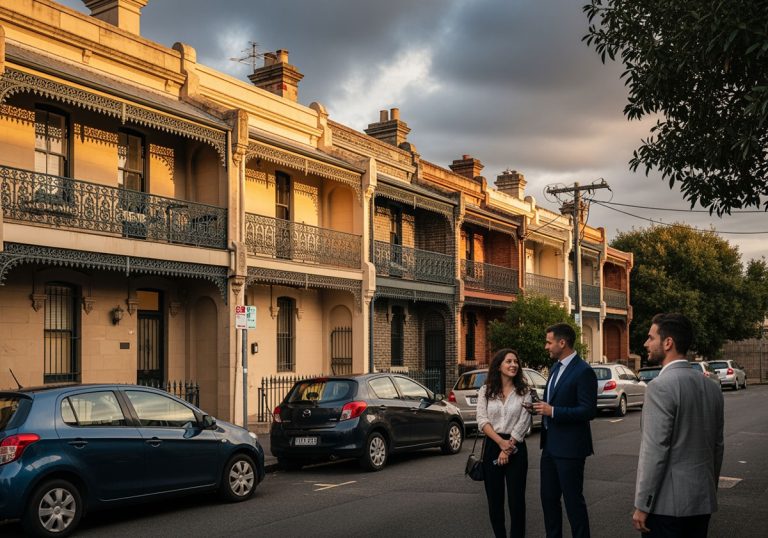
With no strata levies and with superior capital growth potential, houses remain the preferred property type for buyers. If you are seriously considering buying a house in Sydney, how much is it likely to cost you? This article examines the true cost of purchasing a house in Sydney in 2026, incorporating median prices, regional variations, ancillary expenses, and future projections.
As buyers’ agents based in Leichhardt, Inner West Sydney, we constantly analyse the property market to guide discerning property buyers.
Understanding Median House Prices
Median house prices represent the middle value in a dataset of sold properties, where half the houses sell for more and half for less. This figure indicates the most commonly traded price point but does not reflect every property; for instance, a two-bedroom house often trades below the median, while three- or four-bedroom family homes command premiums. Desirable features such as proximity to schools, transport, or waterfronts push prices higher, meaning the median excludes the best or most sought-after properties.
According to Domain, Greater Sydney’s median house price hit a record of $1,759,909 in December, 2025, reflecting robust demand amid limited supply. This metric serves as a benchmark for property buyers assessing affordability, yet individual suburbs and property types vary significantly.
Regional Median House Prices
Sydney’s market segments into distinct regions, each with unique characteristics influencing prices. At Buyer’s Domain, we focus mainly on key areas relevant to our Inner West expertise: Inner West, Eastern Suburbs, Lower North Shore and St George.
In the Inner West, which we know intimately as our base is in Leichhardt, the median house price hovers around $2.2 million. Specific suburbs highlight this range: Leichhardt at $2.2 million, Marrickville at $2.175 million, and Balmain at $2.97million (as per realestate.com.au, 29 January, 2026) , driven by heritage appeal and lifestyle amenities.
Eastern Suburbs medians sat at $3.05 million in June, 2025 (according to OpenStats). Prestige pockets like Bellevue Hill and Point Piper have significantly higher medians in excess of $10 million as these areas appeal to high net worth buyers seeking lifestyle choices and exclusivity.
The Lower North Shore records medians around $2.5 million to $3 million, with Kirribilli at $4.2 million and Mosman sitting higher at $5.82 million, bolstered by harbour views and proximity to the CBD.
The St George region, including suburbs like Brighton-Le-Sands at $2.15 million, typically sees medians near $1.8 million to $2.2 million, offering value relative to the Eastern Suburbs, Lower North Shore and Inner West, with its strong family appeal.
Cheapest Sydney Region
Overall, the Western Suburbs emerge as Sydney’s cheapest region for houses in 2026, with medians under $1.2 million in key growth areas like Penrith and Blacktown. Pockets in some outer southwest areas, including Campbelltown ($965,210) provide greater affordability. Property buyers targeting entry-level markets find opportunities here, though competition remains fierce fuelled by population growth and investor demand. The development of the Western Sydney International Airport is reshaping the property markets in these areas.
Ancillary Costs Explained
Beyond the purchase price iteself, property buyers face significant ancillary costs that can add 4-5% or more to the total outlay. Stamp duty in NSW, calculated on a sliding scale, dominates: for a $2 million property, it equates to $92,012.
Legal fees for conveyancing typically range from $1,500 to $2,500, covering contract reviews and title transfers. Building and pest inspection reports cost $500 to $1,000 each, essential for uncovering defects and any structural issues. (These are often provided free of charge or at a discounted fee if arranged by the selling agent but you should question whether there may be a conflict of interests in relying on reports organized or paid for by the vendor. On the other hand, if you miss out on the first property and pay for reports on several properties, the cost of reports can escalate.) Other expenses can include mortgage registration fees ($175.70), transfer registration fees ($175.70), and potential lender’s mortgage insurance if the deposit is below 20%. We advise property buyers to budget comprehensively, as these costs materialise upfront.
Total Cost Breakdown Table
We have compiled median house prices for each region with estimated ancillary costs (stamp duty calculated per NSW rates for owner-occupiers, plus $2,000 legal fees and $750 inspections). Totals provide a realistic purchase indication.
| Region | Median House Price | Stamp Duty (approx.) | Ancillary Costs | Total Estimated Cost |
| Inner West | $2,200,000 | $103,012 | $3,000 | $2,306,012 |
| Eastern Suburbs | $3,050,000 | $149,762 | $3,000 | $3,202,762 |
| Lower North Shore | $2,750,000 | $133,262 | $3,000 | $2,886,262 |
| St George | $2,000,000 | $92,012 | $3,000 | $2,095,012 |
| Western Suburbs | $1,000,000 | $39,412 | $3,000 | $1,042,412 |
Note: Stamp duty uses general rates; first-home concessions may reduce figures for eligible buyers.
Market Sustainability Assessment
Sydney’s median house price of approximately $1.76 million reflects its position as one of the world’s most desirable and supply-constrained global cities rather than an outlier driven by excess. When compared with international peers such as London (median around AUD $1.3 million – $1.6 million), New York (approximately AUD $1.35 million – $2.4 million), and Singapore (approximately AUD $5.6 million), Sydney stands apart for its combination of strong population growth, limited developable land, political stability, and exceptional lifestyle appeal. Unlike many global cities, Sydney offers proximity to beaches, a temperate climate, and comparatively low-density housing within commuting distance of a major CBD. These are attributes that are increasingly scarce worldwide. Ongoing demand from both domestic and international buyers, coupled with chronic housing undersupply, continues to underpin price resilience, particularly for houses. While affordability remains a challenge, Sydney’s housing market is best viewed as structurally supported by long-term fundamentals rather than short-term speculation, reinforcing its reputation as a highly sought-after and enduring residential market.
2026 Price Predictions
Expert forecasts project Sydney house prices to rise 5-7% by year-end 2026, with Domain predicting a 7% lift to near $1.92 million city-wide. KPMG anticipates 5.8% growth, driven by undersupply and demand. Regional variations may amplify this, particularly in more affordable parts of the city. Engaging buyers’ agents like us secures competitive edges now and avoids paying higher property prices down the track.
Impact of Waiting 12 Months
A 7% increase on current medians would add substantial sums, underscoring the urgency for decisive action. We illustrate this in the table below, using regional medians and applying the consensus forecast.
| Region | Current Median | Projected Median (End 2026) | 7% Increase Amount |
| Inner West | $2,200,000 | $2,354,000 | $154,000 |
| Eastern Suburbs | $3,050,000 | $3,263,500 | $213,500 |
| Lower North Shore | $2,7500,000 | $2,942,500 | $192,500 |
| St George | $2,000,000 | $2,140,000 | $140,000 |
| Western Suburbs | $1,000,000 | $1,070,000 | $70,000 |
These projections highlight potential savings: in the Inner West, waiting until the end of the year is likely to cost you $154,000 extra. Buyers’ agents at Buyer’s Domain negotiate superior outcomes faster, mitigating these escalating rises—contact us to act swiftly.
Why Partner with Buyer’s Domain
Delay can cost you money. Inexperience organising due diligence and paying for multiple building reports can cost you money. As specialist buyers’ agents in Leichhardt serving Inner West and greater Sydney, we leverage market intelligence to identify undervalued properties and negotiate aggressively. Our service saves clients thousands, navigating complexities from inspections to contracts. In a rising market, our expertise delivers results—contact us for personalised guidance.
We target off-market opportunities and highly vendor motivated vendors with our network uncovering listings before public exposure. This maximises value.
Act early to avoid higher costs.